

Welcome to Second Rough Draft, a newsletter about journalism in our time, how it (often its business) is evolving, and the challenges it faces.
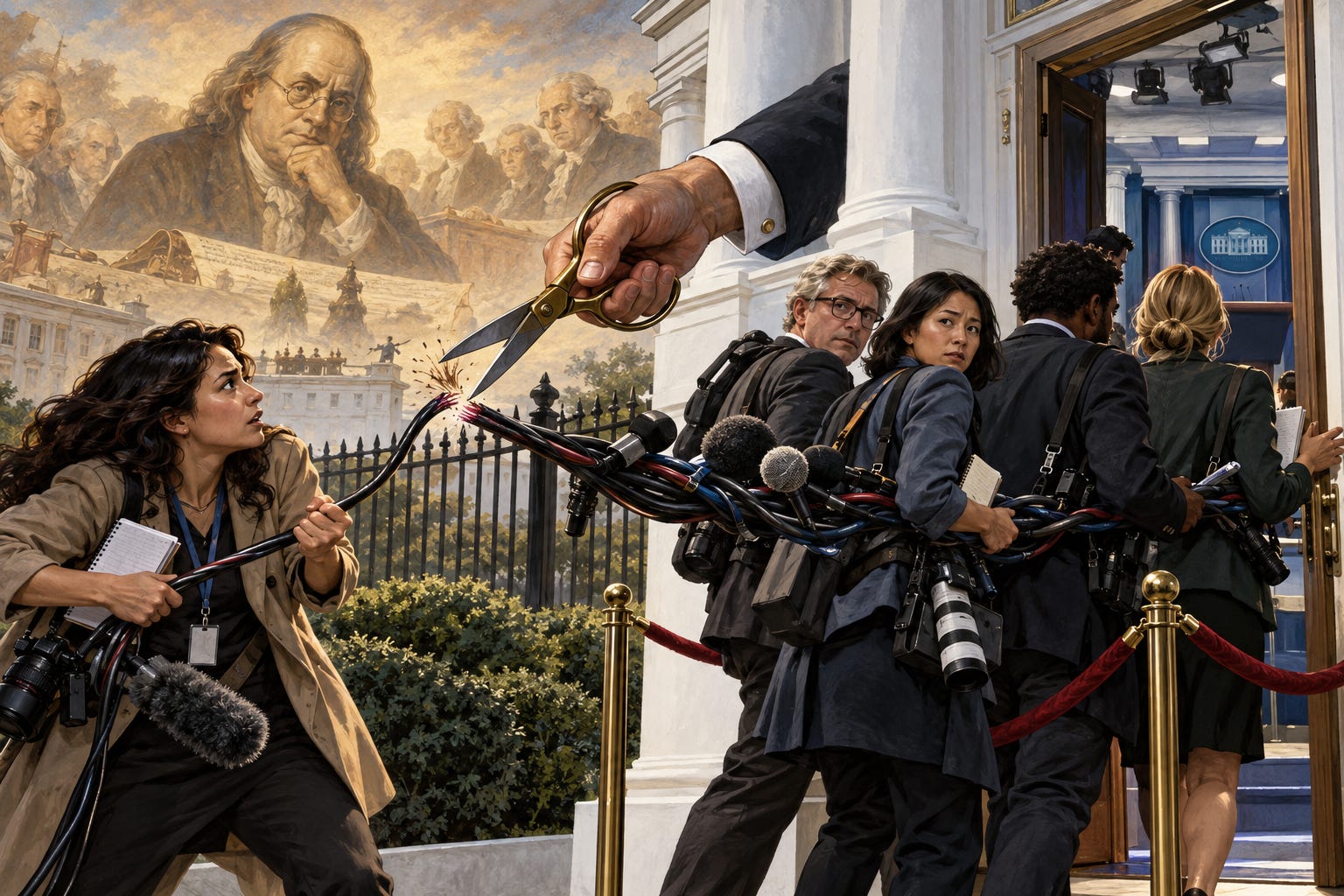
As the Declaration of Independence was being signed in Philadelphia in July 1776, Benjamin Franklin may not have actually said that “We must all hang together, or most assuredly we will all hang separately.” But the sentiment was apt to the occasion—the signers were either declaring independence or committing treason, depending on how things were going to turn out.
Now the same choice metaphorically applies to the White House press corps, and, unlike the founders, they are wavering in the moment. This week I want to explain why I think that could be a big mistake.
Since last year, Trump has shown that he is prepared to use access to the White House to try to extort more favorable or conforming press coverage. It began with punishing the Associated Press for refusing to change its influential Stylebook to adopt Trump’s ridiculous re-naming of the Gulf of Mexico. I said then the time had come for collective action by the press. Unless you count press releases, editorials and amicus briefs as “action,” that’s not what happened.
Instead, while ostensibly cheering on AP, the press was satisfied with leaving the matter to the courts. In line with precedent both from the 1970s and from Trump’s first term temper tantrum directed at Jim Acosta, the courts held last year that AP’s general access to the White House could not be restricted because of the President’s objection to the content they were legally publishing. Round one to AP. But then the White House tried a new tack, curtailing AP’s participation in pool coverage, which is not something open to most outlets with White House passes, a distinction which some courts consider meaningful. So far, and perhaps ultimately, round two on this legal dispute has gone to Trump. (I don’t think that’s the right result, but I’m just a retired press lawyer, not a federal judge.)
What’s at stake
As I’ve said before, however, whether these restrictions are constitutionally permissible is not the only question, nor the biggest one. More important is whether the restrictions are right—and they are not. The ability to cover a public official should not depend in any way on whether that official is enjoying the coverage.
Last month, having succeeded in some measure of punishment for AP, Trump turned his mercurial wrath on CNN, MS Now and Politico, banning their reporters from the White House campus altogether. The remaining four major TV networks, ABC, CBS, Fox and NBC, seemed to have learned something from the AP debacle. Even as the three banned newsrooms went to court (a case everyone familiar with the relevant case law knew they were sure to win), the other networks refused to join the TV pool without CNN. Trump was left with a silent movie version of the debut of his treasured helipad and subject to the less draconian rules of other venues, ranging from the UN to New York’s mayoral Gracie Mansion. Still photographers from other leading outlets placed embargoes of a few hours on their own work in sympathy, a weird half measure without persuasive rationale. The rest of the press corps, despite all of this, resorted to the litany of press releases, editorials and amicus briefs.
In due course, and quickly, Trump lost the court battle with CNN, MS Now and Politico, and, after a few hours of bumbling resistance by the White House, they were back on campus. But Trump’s cronies, presumably harking back to the AP case, realized that they were probably on stronger legal ground to exclude CNN from pool coverage, even as their press passes remained valid, and so, last weekend they barred CNN from such a pool, beginning the next round of the confrontation.
This time, instead of again refusing to collaborate, the other four networks temporized: they indicated they would refuse to join the pool every fifth day, when CNN’s turn came in rotation. Call it the 20% Boycott, which will likely go into effect at least for today.
Moderation in the pursuit of justice is no virtue
But measures like the 20% Boycott, even if momentarily effective, are an effort to balance the desire to cover potentially important news with a core principle of a democratic society, or perhaps another move to defer questions of principle entirely to courts, which use other yardsticks. Either way, such an approach seems to me a huge mistake. It is reminiscent of when a leading publishing executive told me privately last year, at the time of the first AP clash, that “people closer to the situation” thought that collective action was at least premature and thus unwise. You would have hoped that subsequent repressive steps would have taught the lesson that, whatever their perch, those people’s judgment has proven unsound.
What should the White House press corps be doing? I think the rule is straightforward: If Trump (or any successor) bars any news outlet from any sort of controlled coverage for content-based reasons, no other news outlet should participate in that coverage. If AP isn’t allowed in the Oval Office or on Air Force One, no press should go there. If CNN is excluded from the pool, no press—video or text—should participate. Mount your reporting from elsewhere, as the Pentagon press corps has learned to do.
The alternative, it should be increasingly clear, is compromise with acts of tyranny, and compromise of our own principles. That is not the way principles are supposed to work.
Beyond that, it is and should be critical how we communicate about this and related matters to our readers, listeners and viewers. Quiet protests, seeking to reason with plainly unreasonable people, are not enough. The spectacle, for instance, of Trump being given a pass to publicly and personally bully individual reporters, often in disgusting displays of misogyny, while others stand silently by, craving their moment in the spotlight, should have ended long ago. The next interlocutor, in such cases, should begin with, “Mr. President, you owe _____ an apology for that outburst. My question is…” That’s simply in line with the basic manners our parents, one hopes, taught us all.
Even more important, if we are steadfast in maintaining that Trump has no right to punish coverage he doesn’t like, Americans may understand. Most of them will, I believe. If, instead, we fail to hang together, and temporize, haggling with the autocrat, we should not be surprised if they conclude that we value access more highly than freedom. The loss from that could be incalculable.
Where's the power here? From my perspective, Trump has undermined the power of the press by confirming that they need him more than he needs them given that (a) he has direct access to his fans and that (b) the press Is convinced they cannot retain credibility without covering him. I'd argue that they could cover him in very different ways, more creative and expensive, than having resident crews at the White House with Pavlovian habits, but there's no danger of that happening.
This is a great piece even by Dick's high standards.
The Republicans caved en masse (note that they were clearly privately what a disaster Hegseth was but voted for him anyway). I'm not sure that the SCOTUS caved - they (enough of them) seemed bought in to the efforts to denature democracy and rewind history (ironically in the name of conservatism). We will see if elections work, but the press is clearly our ne plus ultra defense. Without consciousness we have no way to make choices, as in elections.
Let's end this slouching.