

Welcome to Second Rough Draft, a newsletter about journalism in our time, how it (often its business) is evolving, and the challenges it faces.
When I say publicly, as I occasionally do, that most of the nation’s for-profit metro newspapers are going out of business in slow motion, journalists in the audience frequently seem skeptical, and suggest that I’m being hyperbolic, and ignoring the progress that is being made in some places. They offer an encouraging anecdote or two, and hope the conversation can move on to happier topics (which, in journalism, would be just about anything).
But earlier this month we got what amounts to a candid confirmation of this death spiral, and I think it’s worth your time this week for us to focus on it.
The confirmation came from McClatchy, publishers of 29 papers in 14 states, including a number of the old Knight-Ridder offerings. McClatchy holdings currently include the Miami Herald, Charlotte Observer, Kansas City Star, Lexington Herald-Leader, Sacramento, Modesto and Fresno Bees and Idaho Statesman. Since emerging from bankruptcy as an independent public company in 2020, McClatchy has been controlled by a New Jersey hedge fund which has since separately entered into a consent decree on charges of improper securities trading.
Here’s what management said on confirming a reported 90 newsroom layoffs at 17 papers on the eve of September 11: For five years, the company “made a deliberate choice to maintain our investment in local news reporters.” Here’s what that means: they had earlier eliminated McClatchy’s prize-winning Washington bureau, as well as the chain’s breaking-news desk, and had allowed local news expenses to “remain largely flat,” which equates to reducing their commitment by roughly the rate of inflation-- a bit over 20% over that time period.
Discovering that less is not more
While thus offering substantially less to readers, they had somehow expected, they say, that “continued investment in our journalism would strengthen our relationship with subscribers.” That is, that offering smaller and less tasty candy bars would lead to more sales. Of course, it didn’t work out that way. Consumer revenue fell 41%. (Note the implicit acknowledgment that advertising— not even mentioned— would fall, on a secular basis, no mattter what.)
Now, McClatchy continues, “we cannot continue investing [in the sense of spending at all, rather than increasing spending] where subscriber interest does not support the investment.” In other words, it’s the readers’ fault. “We need to listen to subscribers,” they say, so they’re going to degrade the products further. The plan is to focus on “where journalism can have the greatest impact” and on what “subscribers value.”
What that means in practice is eliminating one third of the newsroom at the flagship Miami Herald, including almost the entire news staff of El Nuevo Herald, and the reporter covering Miami City Hall; one-third of the unionized staff at papers in the Pacific Northwest, including more than half of the newsroom in Idaho; more than half the news staff in Lexington, Kentucky; almost a quarter of the news staff in Charlotte; most of the local government reporters in Kansas City; the entire sports staff in Sacramento; and two accountability and investigative reporters in Fresno.
Notably, the California cuts— at least 18 newsroom jobs— were not prevented by a new tax break incentivizing newsroom retention that has passed that state’s legislature and is sitting on the desk of Gov. Gavin Newsom. It would have offered refundable tax credits of roughly $325,000 per year to save those California jobs.
Where this is going
Let’s not keep kidding ourselves. The effect of these cuts will be to further eat into readership, for the same reason that slower erosion over the last five years had that result. Following the logic of this month’s cuts, then, there will be more cuts somewhere down the road. Eventually, one by one, the papers will become sufficiently unprofitable that more cuts will not be attractive even to the hedge fund and the newsrooms will shut down (or, perhaps in some communities, be given away to nonprofits, if pockets deep enough to fund the losses can be identified).
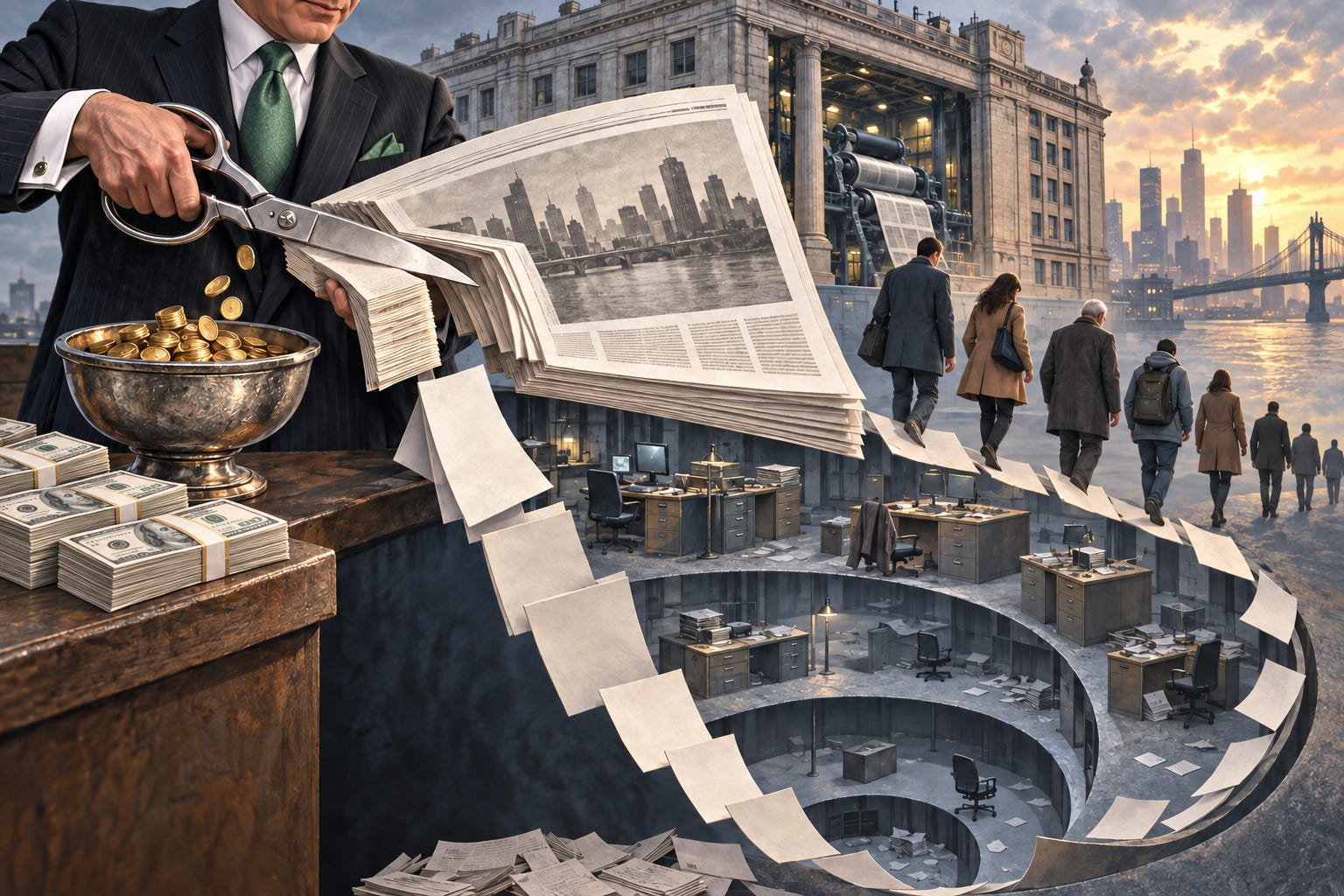
Nor is there any reason to believe that other hedge fund or private equity newspaper owners will behave differently, even if they may not be quite so candid about it. And about three out of four of the country’s largest metro papers are now in such hands—that is, their owners are literally only in it for the money.
McClatchy may hope that AI can somehow delay or avoid this fate—they aren’t saying, but there are signs. While the company was slowly bleeding its news operation, even before the recent amputations, it was pushing AI adoption hard, and utilizing it to create more and more content. In my own view, this may fool some subscribers some of the time, but is unlikely to fundamentally change the dynamic.
The tragedy here is that there might be an alternative. Bigger candy bars may not be possible, but tastier ones could be. For that, however, you would need some vision of what constitutes “tasty.” In this month’s layoffs, McClatchy fired sports reporters, data reporters, investigative reporters, education reporters, environment reporters and local government reporters. It is impossible for me to divine where it believes journalism has the “greatest impact,” or what “subscribers most value,” from this themeless pudding.
In that is the tragedy of our country’s metropolitan newspapers having fallen into the hands of moneychangers. They simply lack any facility for publishing’s unique chemistry, substituting buzzwords and platitudes for editorial vision. Such an approach can only have one outcome, and the sooner we all reckon with it, the better off we will be.
Didn't realize the way they use readers/subscribers/community as cover for what they are doing. Thanks for lifting that up.
This move is actually also used by folks in the not for profit space, who substitute "community engagement, deep listening sessions, two way conversation...etc" for making journalism that people want to read and that helps them live their lives. T
If your audience is going down, its going down because people are less interested in your product. Making an interesting product is most of management's job.
As I recall, this was the news organization that blew the whistle on the weapons of mass destruction rationale for the Iraq war. That ethos no doubt inspired great local reporting as well. Vampire squids strike again.